
How to Make your Brand Stand Out
Being a newbie in any industry is tough, most especially in the cutthroat world of food and bever-ag...

CITEM advises all exhibitors, buyers, suppliers, service providers, partners, stakeholders, and the public to remain vigilant against unauthorized individuals, groups, or third-party entities falsely claiming to represent CITEM and its official programs and events.
These unauthorized communications may be sent through email, calls, SMS/text messages, social media, messaging applications, websites, or other digital channels. They may involve the alleged selling, distribution, or unauthorized access to CITEM data, databases, or contact lists. They may also involve solicitations, donation requests, sponsorship offers, payment instructions, or other monetary requests using the name of CITEM, its officials, personnel, events, or partners.
Please be reminded:
Official CITEM communications are sent only through verified official channels and corporate email domains, including @citem.com.ph.
CITEM does not authorize any individual, third-party entity, or unofficial representative to sell, distribute, share, or provide access to its official data, databases, contact lists, or stakeholder information.
CITEM does not authorize donations, sponsorship payments, direct fund transfers, e-wallet payments, or other monetary transactions through personal accounts or unofficial channels.
Do not click links, download attachments, reply, provide information, or make payments in response to suspicious communications.
If you receive any suspicious communication claiming to be connected with CITEM, please verify directly with your official project focal point or through CITEM’s official communication channels.
Thank you for your continued cooperation and vigilance.
Center for International Trade Expositions and Missions
September 18, 2026
With naturally bright flavors, strong fruit-growing regions, and a growing base of specialty producers, the Philippines offers distinctive possibilities for fruit wines and fermented drinks.
There is a moment when a ripe Philippine mango is split open in the heat, where the scent alone feels like a flavor. Sweet, floral, and faintly woodsy — it is the kind of aroma that lingers. Now imagine that held in a bottle. Not as juice, not as nectar, but as something fermented, refined, and ready to be poured at a table anywhere in the world, with people reaching for something they have not tasted before.
This is what a growing number of Philippine producers are beginning to do.
Across the Philippine archipelago, fermentation has never been a foreign concept. Long before specialty retail or craft beverage culture found its footing, Filipino communities were drawing on local harvests to make drinks of their own. Tuba, a wine drawn from freshly cut coconut palm sap, has been part of coastal life for centuries — mildly sweet when fresh, sharpening into something earthier and more complex as it ages. Tapuy, a rice wine made in the Cordillera highlands of northern Luzon, carries a cloudy, slightly sour depth that varies from village to village depending on the fermentation starter used.
These traditions are not relics. They are a root system. What is happening now — with bottled wines flavored with Philippine tropical fruits reaching specialty shelves— is a continuation of that instinct, updated for a wider audience and a more discerning market.
The timing is not incidental. The global fermented beverages market was valued at approximately US$951.2 billion in 2024 and is projected to reach US$1.7 trillion by 2034 (Global Market Insights, 2025). Growth is being supported by product innovation, new flavor offerings, and interest in craft and premium beverages, including fruit wines. For Philippine producers, this creates opportunities to differentiate through distinctive tropical ingredients and locally rooted products.They are paying closer attention to origin, craft, and what makes one bottle different from another. For Philippine producers working with native fruits and local fermentation knowledge, that shift is an opening.
What makes Philippine tropical fruit particularly well-suited to fermentation is not just abundance — it is character. These fruits are not mild. Calamansi, the small citrus native to the Philippines, delivers a tartness that is brighter and more aromatic than lemon, cutting through a ferment with a clean, citrusy edge. Bignay, the native currant tree fruit found across Luzon, ferments into deep garnet wines with a tannic structure closer to red grape wine than most people expect from a tropical ingredient. Santol, known outside the Philippines as cotton fruit, carries a milky sweetness and a faint astringency that gives fermented versions a lingering, multi-layered finish.
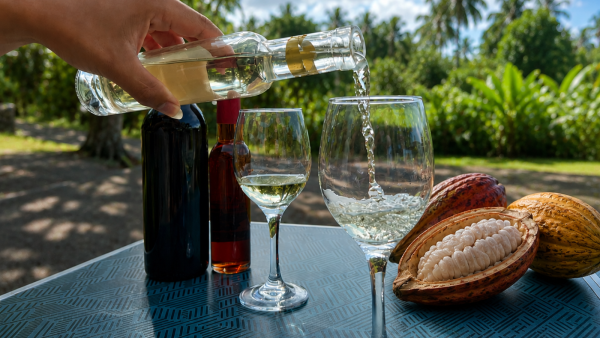
Mango and pineapple, more familiar to international buyers, bring high natural sugar content and aromatic intensity that make fermentation technically easier and the resulting product more immediately approachable. Bananas add body. Lemongrass adds lift. Cacao, when worked into a fermented base, introduces an unexpected earthiness that rounds the profile in a way that grape tannins rarely can.
Taken together, these tropical fruits showcase the breadth of flavors found across the Philippines. Their naturally diverse sugar, acid, and tannin profiles translate into wines with distinctive character, creating a category defined not by comparison to grape wine, but by the unique qualities of the fruits themselves.
A handful of Philippine producers are doing this work with real intention, and their products are beginning to show the range of what the category can hold.
Homegrown pioneer Destileria Barako Corporation works on the craft spirits end of the spectrum, drawing on local ingredients and Philippine distillation heritage to produce beverages with the kind of depth that comes from a close relationship between raw material and process.
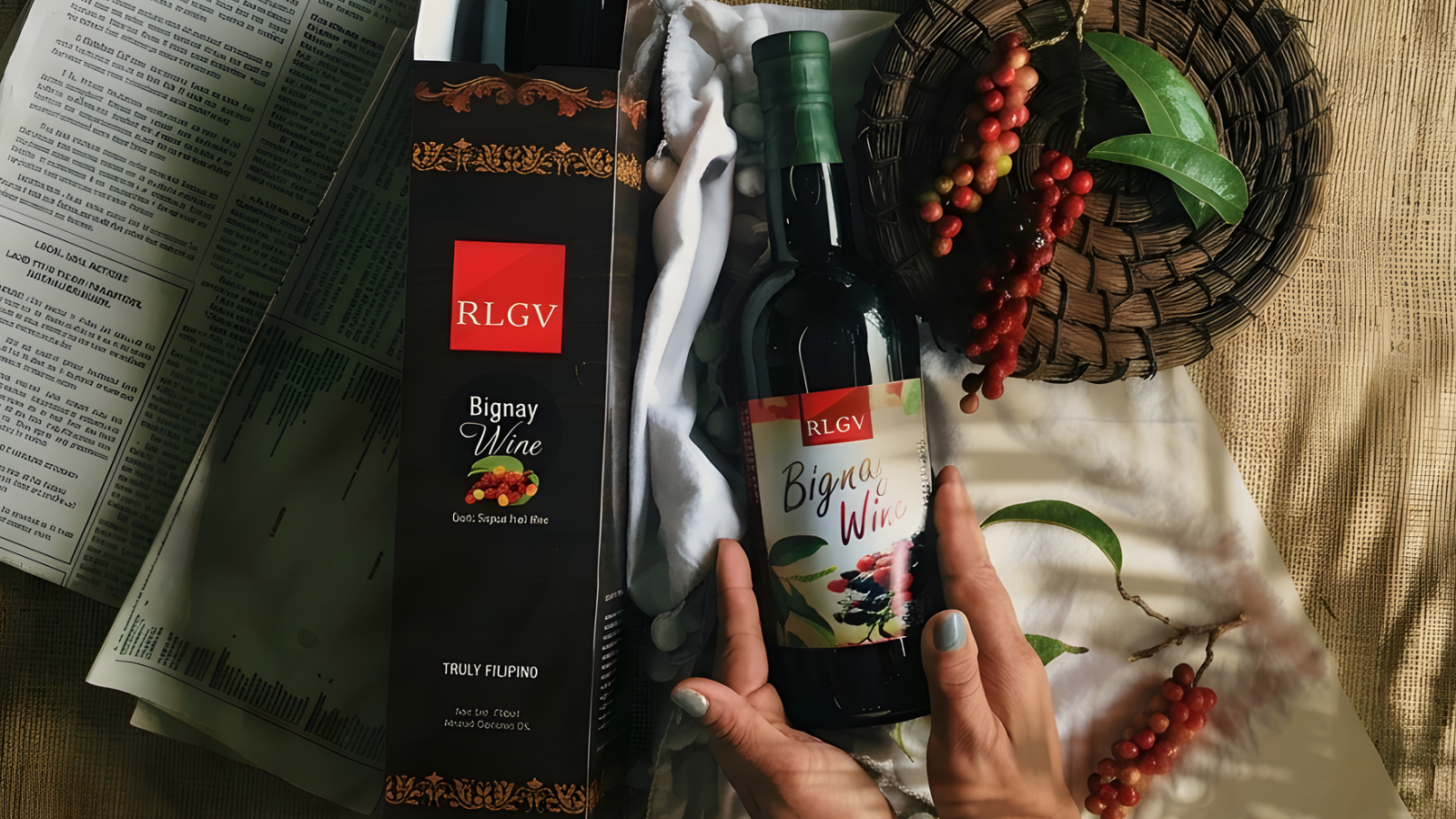
RLGV Fruit Wines Industry has built a focused identity around native fruits — bignay in particular. Their small-batch wines carry a color that earns attention before the first sip: a deep, dark red that settles in the glass like something that has been carefully coaxed out of the land rather than manufactured.
Federico's Island Wine approaches the category with a lighter touch — fruit wines that are intended to be approachable without being simple, the kind of bottle that works at a dinner table or as a travel gift without requiring explanation.
Alden Therese Food Industry takes perhaps the broadest view — fermenting banana, santol, lemongrass, and cacao into a collection of products that reads like an inventory of what Isabela's harvests can become when handled with curiosity. The lemongrass expressions in particular carry a floral herbaceousness that sits well outside what most wine drinkers expect, and exactly where specialty beverage buyers are looking.
For buyers in specialty retail, hospitality, or gifting — particularly those building shelves and menus that reward curiosity — Philippine fruit wines and fermented beverages offer something that is increasingly hard to find: a product with genuine origin, made in small quantities, from ingredients that carry a story most consumers have never encountered in bottled form.
These are not mass-market alternatives to grape wine or cider. They are not trying to replace anything. They are a different conversation — one that starts with a specific tree, a specific island, a specific harvest — and ends in a glass with something worth talking about.
Bottled fruit wines and other fermented beverages generally offer greater shelf stability and distribution practicality than fresh fruit, while providing another way to showcase Philippine ingredients and provenance. For buyers seeking to introduce these flavors to new markets and contexts, they offer a distinctive and commercially practical entry point.
Producers developing these products can be found through IFEX Philippines and IFEXConnect — where buyers can explore product lines, connect directly with makers, and begin sourcing conversations.
*****
Banner caption: Made from locally grown bignay, a native Philippine fruit, is used in wine-making because of its natural flavor and color. Photo credit: RLGV Fruit Wine Industry.
Being a newbie in any industry is tough, most especially in the cutthroat world of food and bever-ag...

In April 2020, mountains of surplus broccoli and cauliflower were pictured decaying in the Mountain...

A country renowned for its pristine beaches and infectious hospitality, the Philippines is also the...

Check out these food fusions between Filipino and Middle Eastern cuisines
The unending quest for healthy and sustainable food amid changing lifestyles
A quick look at the Philippine food staple often getting a bad health rap